
PIN POINTTM

Ray Barrett (8/15/2021)
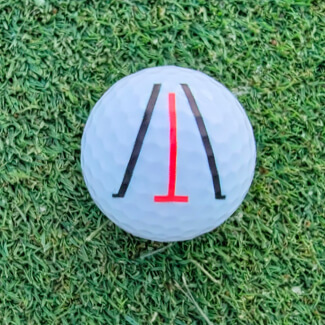
Ray envisioned a triangle minus the tip as a design that would allow the stationary flagstick or a stationary spot on a sloping green to enter into the tip of the triangle resulting in more precise vision in aiming at the target. He felt that by removing the tip of the triangle that is normally the aiming point that this idea would allow the target to be inserted into the tip of the triangle thereby eliminating a step in the aiming process resulting in greater accuracy.
Ray contacted his original Triple Track® team. Dr. Carl Bassi, a vision scientist and professor at University of Missouri-St. Louis, Bob Bain, a patent attorney with the nationwide patent firm Stinson and Jim Holtgrieve who played in 5 masters and the US Open and was a 2-time Walker Cup Captain. They all agreed to participate in Ray’s new entrepreneurial adventure.
Ray’s patent attorney reviewed prior art and gave the green light. Dr. Bassi researched the concept and made recommendations for refining the design. Ray ordered several dozen golf balls with the triangle design and registered the name “Pin Point”. Jim began introducing the Pin PointTM design ball to golfers nationally and the initial feedback was extremely positive.
The center red line acts as an additional aiming aid. The player can line up the target with the red line which is encompassed by the converging outer lines.
The small footing on the base of the center red line helps the player’s putter face align with the ball.
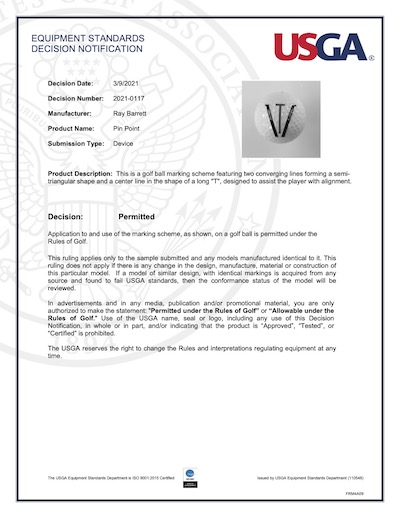
The USGA on March 9th, 2021 notified Ray that the product Pin Point “is allowable under the rules of golf”.

As of August 1, golfer feedback was so overwhelmingly positive – for all golfers, especially those who put a single line on their ball, or who use the company logo for alignment – that Ray said, “Let’s go!”
Ray contacted two of his veteran Triple Track associates, Jeff Pickett and Dan Nace. Jeff is an artist and visionary based in Colorado who has the ability to conceptualize an idea and bring it to life through image and motion. Dan is a production expert in film and video, both as a director and award-winning scriptwriter. Both readily agreed to come aboard to help communicate the story and science behind Pin Point™.
Ray now had all the key pieces in place to move forward with his vision for a “V” sight alignment system that could benefit all golfers, regardless of their experience level. The Pin Point™ professional team, the patents, the science, and the golfers’ positive experience have all contributed to the excitement around the golf ball design and, more importantly, the lower scores golfers will be able to achieve.
The attorneys at Stinson expect to have the U.S. and International patents on file by the spring of 2022. While there has been early interest and discussions, the plan is to officially introduce Pin Point to the market in the fall of 2022.